Enterprise AI Architecture: From Pilots to Production
Why enterprises need an AI governance and execution layer
Most organizations already have a strong enterprise architecture. What is missing is the layer that governs how AI accesses those systems.
The Current Enterprise Architecture
Your enterprise architecture is already robust and battle-tested. The systems below represent years of investment, integration, and governance—they work.
The challenge emerges when AI begins to interact with all of these systems simultaneously.
- ERP
- CRM
- Finance
- HR
- SharePoint
- Document repositories
- Knowledge bases
- Data platforms
- APIs
- Integration platforms
- Entra ID
- RBAC
- IAM
The AI Explosion
AI entry points are expanding rapidly across the enterprise. Copilots, AI applications, agents, and automation workflows increasingly connect to business systems, documents, APIs, and data platforms. Without coordination, AI begins to operate as a super-user across the enterprise landscape.
- Microsoft Copilot
- Custom AI applications
- AI agents
- RAG solutions
- Automation platforms
- Documents and knowledge bases
- APIs and integration layers
- Databases and data warehouses
- Core enterprise systems
Today's Enterprise Architecture: Strong Foundation, Missing AI Control Layer
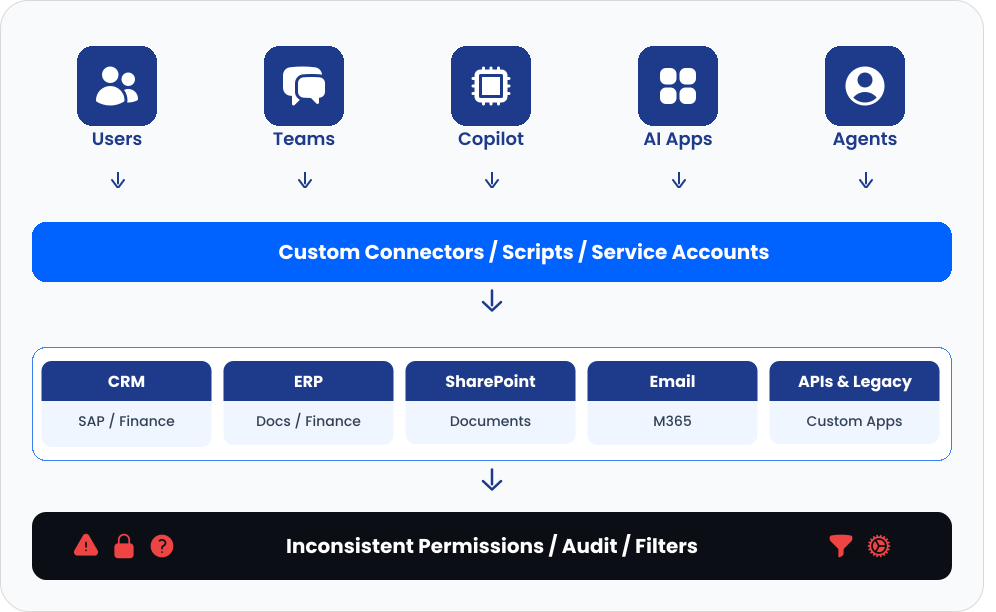
Enterprise environments are built on a mature foundation of systems, including CRM, ERP, document repositories, messaging platforms, and legacy applications, all governed by established identity and access management frameworks.
With the introduction of AI, new execution layers emerge—such as copilots, AI applications, and agents—that interact directly with these systems.
In most implementations, this interaction is enabled through custom connectors, scripts, and service accounts.
This pattern creates architectural challenges:
- Decentralized access control and inconsistent RBAC enforcement
- No unified policy layer across AI interactions
- Limited observability and auditability of AI-driven actions
- Increased attack surface due to unmanaged service identities
As a result, AI operates as a distributed execution layer with broad system access, but without centralized governance.
This is the core architectural gap: the absence of a dedicated control layer to enforce identity, policy, and auditability across all AI-to-system interactions.
What Is Missing Today?
Most enterprise AI architectures are missing core control-plane capabilities required for secure production deployment.
These capabilities include delegated identity, metadata normalization, centralized policy enforcement, end-to-end auditability, governed dev–test–prod promotion, and reusable integration patterns.
Without them, AI operates through fragmented access paths, inconsistent controls, and one-off integrations.
The result is predictable: excessive access, limited traceability, difficulty promoting solutions to production, and poor scalability across use cases.
.svg)
Target Principle: Keep Existing, Insert the Missing Layer
The target architecture preserves existing enterprise systems, security controls, documents, and APIs.
Rather than replacing them, it introduces AI Fabrix as a dedicated governance and execution layer between AI interfaces and backend systems.
This layer standardizes how copilots, AI applications, agents, and user interfaces access enterprise assets while enforcing centralized identity, policy, and audit controls.
The result is a scalable AI architecture that builds on existing investments without creating unmanaged point-to-point integrations.
.png)
The AI Fabrix Approach
AI Fabrix inserts a dedicated governance and execution platform between AI applications and enterprise systems.
It does not replace existing systems; it governs how AI interacts with them.
.svg)
This insertion point is the key architectural decision. By centralizing policy, identity, and integration at this layer, enterprises gain visibility and control over AI interactions across the entire system landscape.
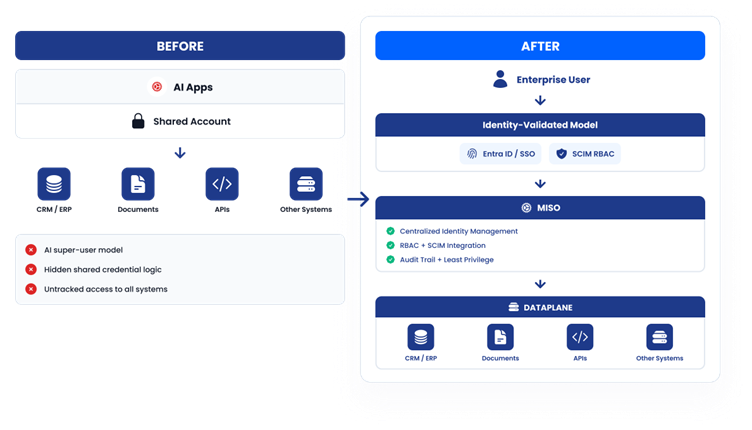
1. Shared-Account Access vs. AI Fabrix Governed Access
AI Fabrix replaces shared-account access with an identity-validated and centrally governed access model, enabling least-privilege execution, RBAC-aligned control, and full auditability across enterprise systems.
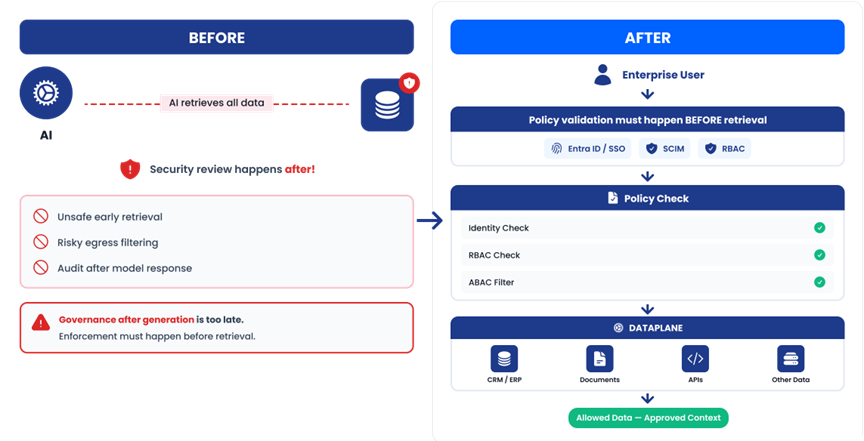
2. Post-Retrieval Controls vs. AI Fabrix Policy-First Retrieval
AI Fabrix shifts governance from post-retrieval review to pre-retrieval policy enforcement, ensuring that identity, RBAC, and attribute-based controls are validated before any enterprise data is accessed.
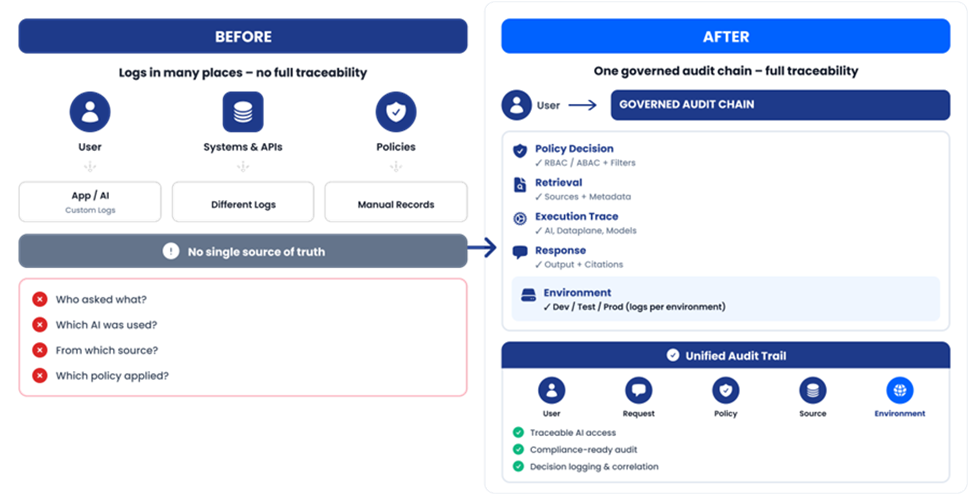
3. Fragmented Logging vs. AI Fabrix Unified Audit Trail
AI Fabrix replaces fragmented logs and manual records with a unified governed audit chain, providing end-to-end traceability across policy decisions, retrieval, execution, response, and environment context.
From Glue Code to Standardized Governance
In many enterprise AI implementations, each use case is built through separate connectors, scripts, or exception paths.
This creates duplicated integration logic, inconsistent controls, and limited scalability.
AI Fabrix replaces this model with a governed, reusable integration pattern in which identity, policy, metadata handling, and audit controls are centralized and reused across use cases.
This creates a more consistent and scalable foundation for enterprise AI deployment.
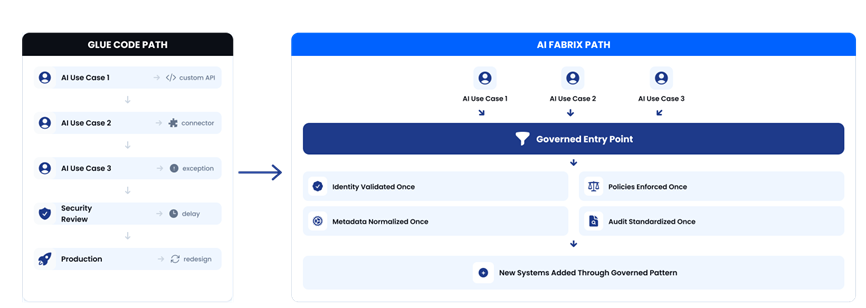
This same pattern extends delivery from one-off integrations to reusable, governed implementation models.
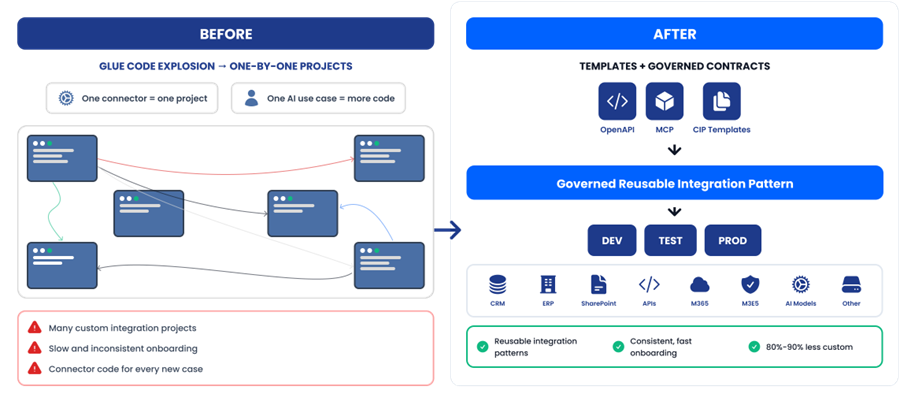
Instead of creating custom integration logic for each AI use case, implementation is based on standardized templates, governed contracts, and a controlled promotion path across development, testing, and production.
This reduces custom code, shortens onboarding time, and enables consistent integration across enterprise systems, APIs, documents, and AI models.
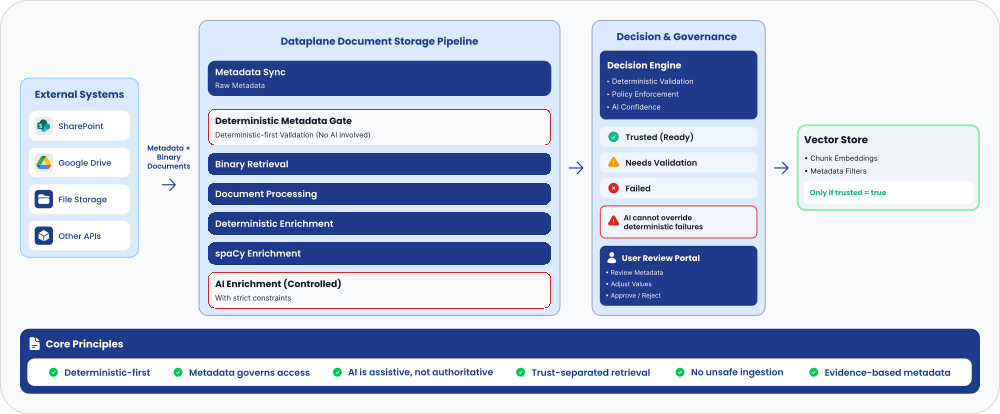
AI Fabrix Dataplane: Document Storage Processing and Governance Flow
AI Fabrix uses a deterministic-first document ingestion pipeline for enterprise content.
Documents from systems such as SharePoint, Google Drive, file storage, and other APIs move through a governed dataplane where metadata is synchronized, validated, retrieved, and enriched in a controlled sequence.
Deterministic checks are applied before any AI-assisted processing, ensuring that governance is based on trusted metadata rather than model output.
Only content that passes decisioning and governance controls is promoted into the vector store with approved metadata and embeddings.
This enables trust-separated retrieval, controlled AI enrichment, and evidence-based metadata handling across the document pipeline.
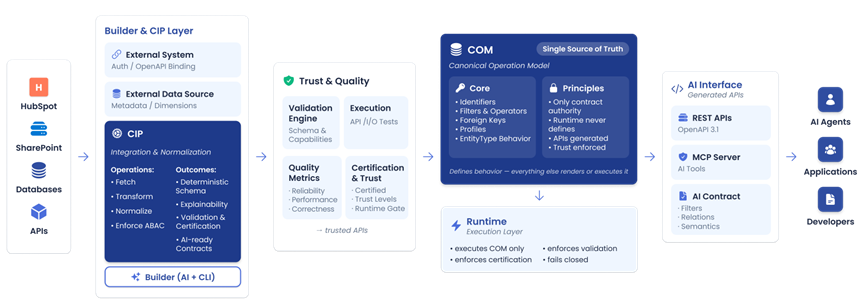
AI Fabrix Dataplane: Trusted AI Data Plane
Building on the governed document pipeline, AI Fabrix applies the same deterministic-first pattern to external systems and APIs.
Source data is normalized, validated, and mapped into a canonical operational model, then exposed through governed interfaces such as REST APIs, MCP Server, and AI contracts for consistent, policy-aligned consumption.
Development to Production Lifecycle
One of the most common failure modes in enterprise AI is the absence of a structured path from experimentation to production.
Many AI solutions are developed as isolated pilots, with limited control over how policies, integrations, runtime behavior, and security constraints are validated before release.
This makes production deployment risky, inconsistent, and difficult to govern at scale.
AI Fabrix addresses this by introducing a governed deployment lifecycle in which solution components, access rules, integration behavior, and execution controls are validated before promotion.
The lifecycle separates development, testing, and production environments, ensuring that each stage has defined controls, repeatable validation steps, and clear promotion criteria.
As a result, AI solutions can move into production through a controlled and policy-aligned process rather than ad hoc release paths.
- AI workflows and agents are built and iterated against sandboxed data and policy configurations.
- Integration, policy compliance, and behavioral tests are executed against a production-mirror environment.
- Only validated, policy-compliant solutions are promoted — with governance controls active from day one.
AI Fabrix Architecture
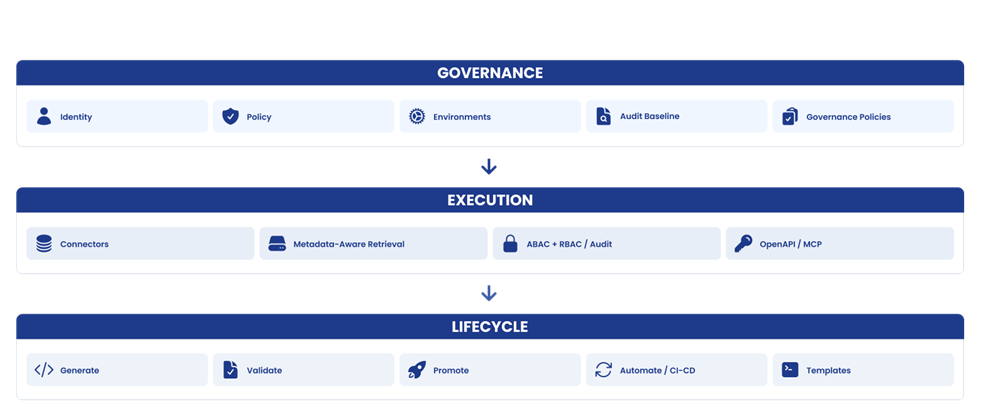
AI Fabrix is structured across three operational layers: governance, execution, and lifecycle.
- Governance Layer: Defines the control framework for identity, policy, environments, audit baselines, and governance rules.
- Execution Layer: Applies these controls to runtime interactions through connectors, metadata-aware retrieval, ABAC/RBAC enforcement, auditability, and standardized interfaces such as OpenAPI and MCP.
- Lifecycle Layer: Governs how AI capabilities are generated, validated, promoted, automated through CI/CD, and standardized through templates, providing a controlled path from implementation to production operation.
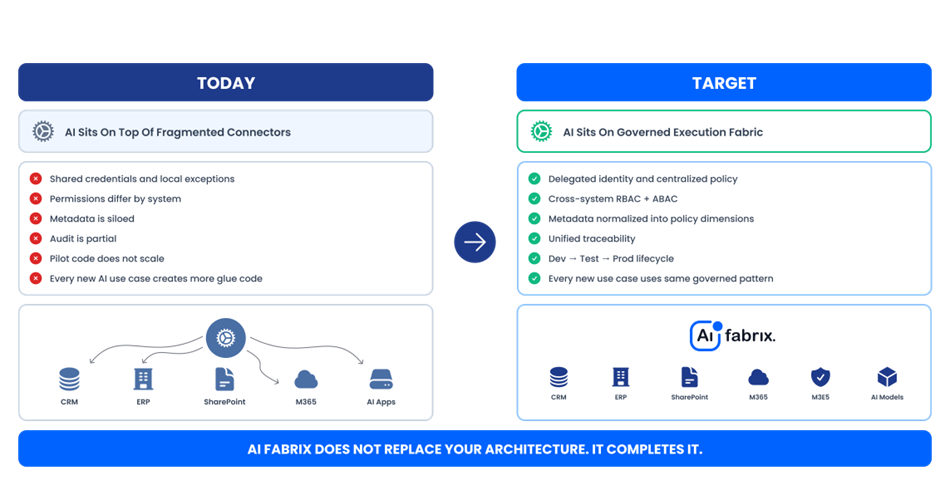
From Fragmented Connectors to Governed Fabric
AI Fabrix defines the target-state architecture for enterprise AI. Instead of placing AI on top of fragmented connectors, shared credentials, and use-case-specific exceptions, it introduces a governed execution fabric that centralizes identity, policy, metadata handling, and traceability across systems.
This preserves the existing enterprise architecture while adding the missing control layer required for secure and scalable AI deployment.
In the target state, access is delegated, policies are enforced consistently across systems, metadata is normalized into a common governance model, and every AI use case follows the same controlled implementation pattern.
The result is a more scalable architecture in which AI no longer depends on fragmented glue code but operates through a repeatable and governed execution model.
AI as an Enterprise Execution Layer
AI is not just another application; it becomes an execution layer across the enterprise—reaching into every system of record, every document repository, and every API.
To scale safely, enterprises need a governed AI architecture in which identity, policy, and auditability are in place before AI reaches production.
|
The Gap is Real
Every enterprise deploying AI without a governance layer is accumulating architectural risk today.
|
The Architecture Exists
AI Fabrix provides the missing governance and execution layer — without replacing what already works.
|
|
The Path is Clear
A structured discovery engagement is the next step toward a production-ready, governed AI architecture.
|
|